

Read Before You Vote!
How election coverage shapes what we notice, what we care about, and how students can read the 2026 midterms with context.

Election coverage can shape how people understand an election before they ever choose a candidate.
When voters read the news, they are not only learning facts. They are also being shown which issues seem urgent, which candidates seem strong or risky, which races matter most, and what questions they should ask. A news story might focus on election security, voter access, candidate experience, party strategy, polling, scandals, or local concerns. Each focus can lead readers to think about the election differently.
That does not mean a news source is always telling people who to vote for. Often, the influence is more subtle. News can shape voters by deciding what to emphasize, what to repeat, what background to include, and what context to leave out.
That is why election coverage is an important media literacy topic. To read election news carefully, students need to ask:
What is this story making me notice?
What issue or concern feels most important after reading it?
What context do I need before forming an opinion?
In this lesson, students use Verity’s US Midterms 2026 portal to practice those questions. Verity gathers major races, context stories, public figures, related controversies, and “Go Deeper” links in one place, making it a useful tool for studying how election stories are framed.
Guiding question: Why might where we get our election news affect how we vote?
Teacher framing
What are Midterm Elections?
In the United States, voters choose a president every four years. But halfway through a president’s term, the country also holds midterm elections. These elections include all 435 seats in the House of Representatives and about one-third of the Senate. Many states and local communities also hold elections for governors, state legislatures, mayors, and other offices.
Midterms matter because they can affect which party controls Congress, what laws are easier or harder to pass, and how people judge the president’s party halfway through a term.
You can show your students this Britannica video: What is a Midterm Election?
Why do we Care About Voting?
More generally, elections are one of the main ways people participate in a democracy. Through elections, voters choose leaders, influence public policy, and help decide who has the power to make laws, spend public money, and represent their communities.
Elections also create accountability. If elected officials want to stay in office, they have a reason to listen to voters, explain their decisions, and respond to public concerns.
But today, we are not debating which party or candidate students should support. We are studying how election news works. We are asking how news coverage can shape what voters notice, what they worry about, and what they think an election is really about.
Warm-Up
Ask students: Imagine two voters are reading about the same election issue. One mostly sees stories about voter fraud and election security. Another mostly sees stories about voter access and registration barriers.
How might those voters come away with different ideas about what matters most?
After students respond, explain: This is one way news can affect elections. It does not have to tell people what to think. It can influence them by shaping what they think about.
Key Idea for Students
Election News can shape:
What we know: the facts and background we are given
What we notice: the issues, people, or conflicts we pay attention to
What we think matters: the problems we believe elections stand on
For older or advanced students, you can introduce some more advanced language to discuss the media’s impact on elections.
For example, you can introduce the idea of issue ownership: the idea that voters may associate certain issues with certain parties or candidates. If news coverage focuses heavily on one issue, it can shape how voters judge an election.
Step 1: Start with the Verity portal
Have students open the US Midterms 2026 portal. Ask them to spend two minutes scanning, not reading deeply yet. You may also ask students to go over the “Go Deeper” section on the Verity Home page to find more stories on the US midterms.
Teacher prompt: What kinds of election information does this portal gather in one place?
Students might notice:
Candidates
States
major races
context stories
public figures
Controversies
left/right or pro/critical establishment indicators
“Go Deeper” links
Then say: A single headline gives us one doorway into a story. A portal lets us see the bigger election map: related people, issues, races, and controversies. That helps us slow down before deciding what a story means.
Step 2: Use the SAVE Act story as the class model
Use Verity’s US Midterms: The SAVE Act story as the shared example.
The story is useful because it does not focus on a candidate, but on election rules. It serves as a good example of how the same issue can be understood in different ways depending on what a story emphasizes.
Write this on the board: Same issue. Different focus. Different voter concerns.
Then walk students through three possible frames from the SAVE Act story:
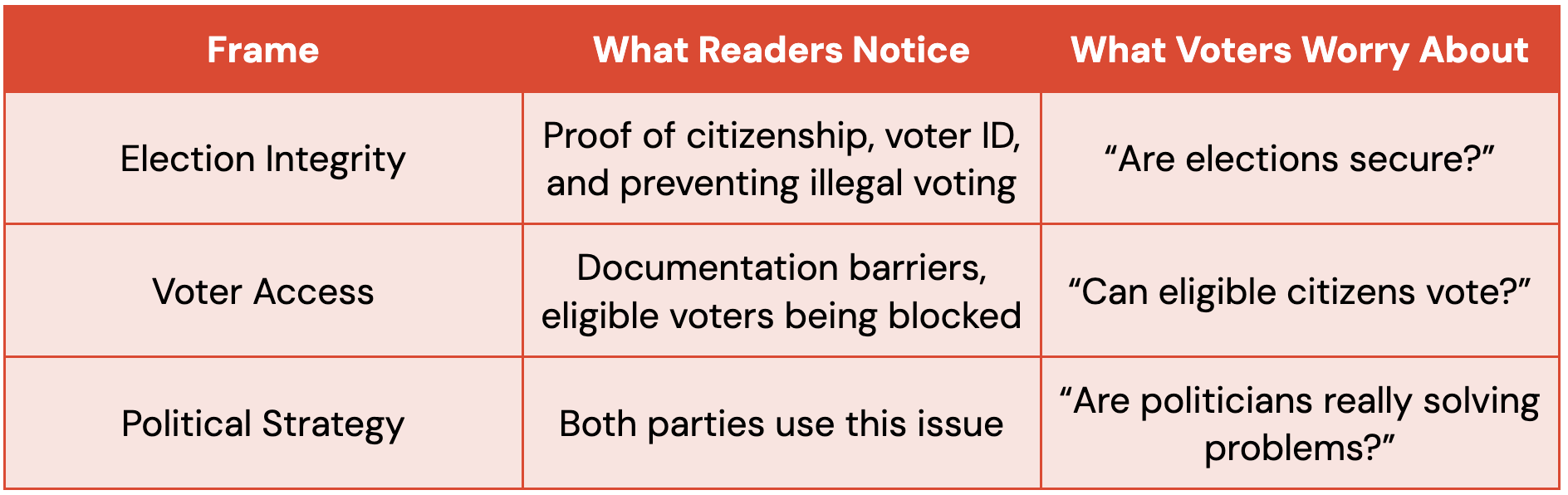
Teacher script: All three frames are about the same law. But each one makes a different concern feel most important. If someone mostly sees the election integrity frame, they may think the biggest problem is election security. If someone mostly sees the voter access frame, they may think the biggest problem is eligible voters being blocked. If someone mostly sees the political strategy frame, they may become more skeptical of both parties.
This is how election coverage can connect to voting. Coverage can shape what problem voters think the election should solve.
Step 3: “What is this story making me care about?”
Students read or skim the SAVE Act story and answer the following questions:
What is the issue?
What are the main frames or narratives?
What does each frame make readers notice?
What concern might each frame create for voters?
What facts would readers need before forming an opinion?
What might be missing from each frame?
Students can complete these independently, in pairs, or in groups.
Then ask: If someone only saw one of these frames, what might they misunderstand?
Students are not just identifying narratives. They are learning how narratives can influence voter priorities.
Step 4: Apply the same skill to candidate coverage
Now we move from an issue story to candidate stories.
Use the Texas Senate Democratic Primary and Texas Senate Republican Primary as examples.
The Texas Democratic primary story asks whether Jasmine Crockett’s rapid rise as an anti-Trump figure makes her the strongest candidate, or whether Democrats need James Talarico’s red-district appeal more.
The Texas Republican primary story asks whether John Cornyn’s experience is what Texas needs, or whether Ken Paxton is the outsider who will shake up Washington. It also includes a third narrative around Wesley Hunt as a next-generation conservative alternative.
Here, the teaching point is: Election stories do not only frame issues. They also frame candidates. Candidate coverage often asks voters to judge personal qualities: experience, electability, independence, loyalty, energy, trust, risk, or ability to win.
Student chart:
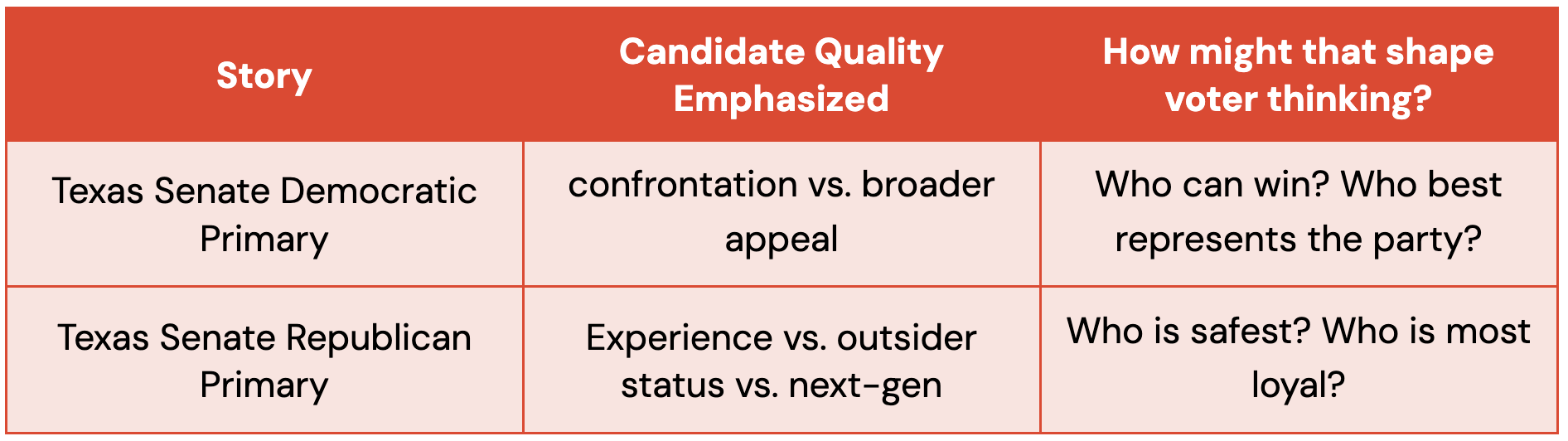
Teacher script: This is why we compare narratives. Not because students need to pick a side, but because voters are often asked to judge candidates through a particular lens. One story might make experience seem most important. Another might make outsider status seem most important. Another might make electability seem most important. Those lenses can shape how people decide.
Step 5: Connect to media influence
At this point, introduce the broader media-literacy concept. Ask: So, why might where someone gets election news affect how they vote?
You might say: Because different sources may emphasize different issues, concerns, candidate qualities, or controversies. That can shape what voters think the election is about and what they believe matters most when choosing a candidate.
One Step Further:
The University of Oregon School of Journalism and Communication describes several ways media can influence elections, identifying 7 trends in 2024.
This includes which candidates receive attention, the “scripts” used to describe candidates, social media filtering, visuals, polling, and the tendency to cover elections like a competition. Going over these with your students can reveal what they can look for when reading election coverage.
This section reaffirms that news we consume can shape three things:
What we know.
What we notice.
What we think matters.
Step 6: Why Verity helps
Verity is useful for this activity because it gives us more than a single headline. It shows context stories, competing narratives, public figures, controversies, and related stories. That helps us compare what different frames emphasize before deciding what we think. Encourage your students to follow the controversies on Verity’s page to identify key election issues and where public figures stand!
Verity is also rated Center by AllSides and has received AllSides Balance Certification, but students should still read actively. A balanced source can help us compare perspectives, but media literacy still requires asking questions, checking context, and noticing what is emphasized.
Exit ticket
Ask students to answer: How could where someone gets election news affect how they vote?
A student's answer might be: It could affect what issues they think are most important, which candidate qualities they notice, and what questions they ask before making a decision.
Final teacher takeaway: This lesson helps students understand elections because it moves them from headline reaction to context-based reading.
They practice asking:
What is this story about?
What is it making me focus on?
What issue or candidate quality feels most important?
What would I think if I only saw this frame?
What context do I need before forming an opinion?
Students are not just learning about the 2026 midterms. They are learning a repeatable method for reading election coverage more carefully.